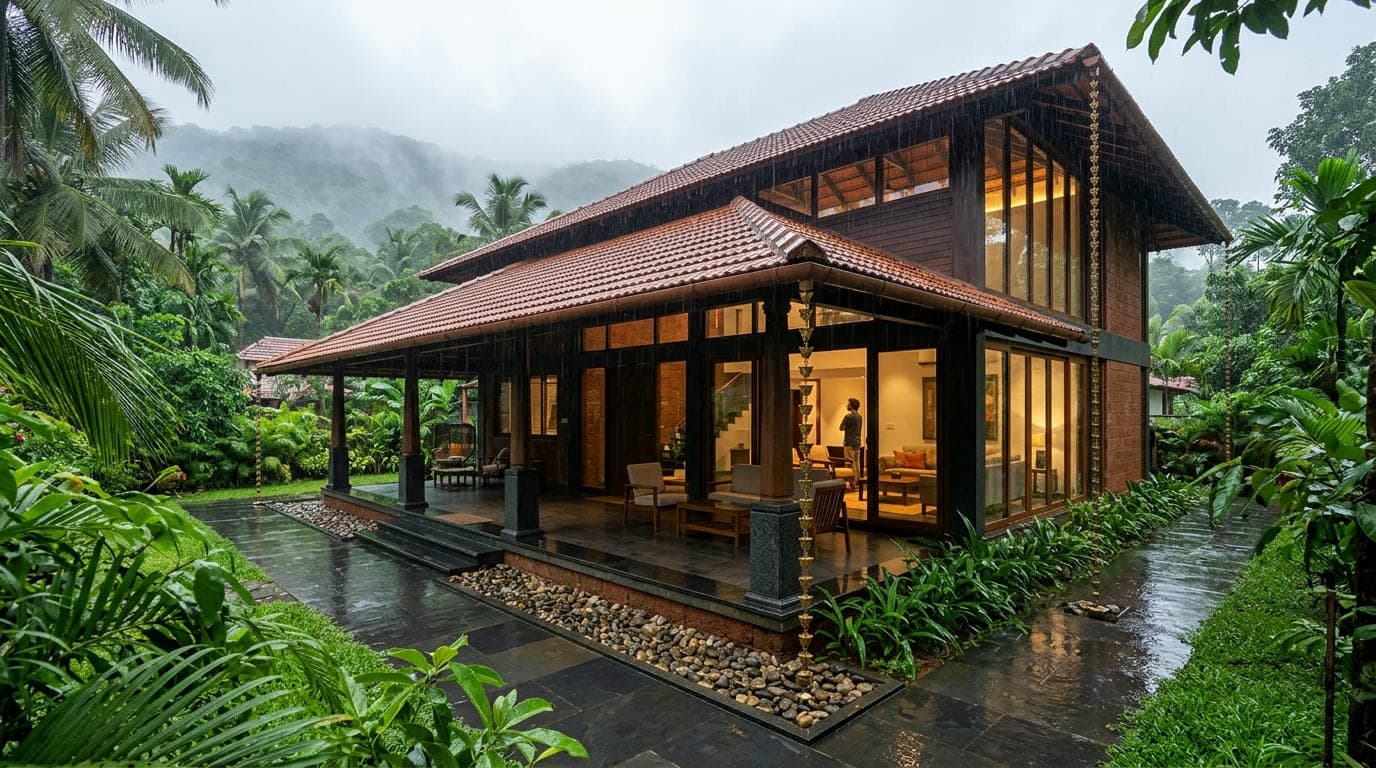
1. The Rising Damp Barrier: Proper Damp-Proof Course (DPC) at Plinth Level
The most common cause of peeling paint and wall dampness in Kerala is capillary suction of ground moisture. Standard practice requires a minimum 50mm thick M20 grade concrete DPC layer laid across the entire plinth beam, coated with two coats of elastomeric bitumen membrane before the first brick course is laid.
- Integral crystalline waterproofing admixtures added directly to plinth concrete.
- Minimum 45cm to 60cm plinth elevation above the surrounding natural ground or road level.
- Bitumen emulsion paint applied along the interior foundation brickwork prior to backfilling.
2. Flat Roof Slab Waterproofing: Beyond Simple Screeding
A flat concrete terrace in Kerala cannot rely on a single cement wash. Extreme thermal expansion under summer sun followed by torrential monsoon deluge creates micro-fissures that leak within 2 years if not engineered properly.
- Mandatory 1:80 slope gradient cast into the concrete screed towards oversized rainwater outlets.
- Multi-coat fiber-reinforced acrylic or polyurethane (PU) waterproof membrane applied over dry concrete.
- Thermal reflective cooling tiles or Mangalore tile truss roofs installed over flat RCC slabs to eradicate solar heat absorption.
3. Roof Overhangs (Sunshades / Chajjas) for Wall Protection
Traditional Kerala architecture utilized massive sloping eaves for a fundamental engineering reason: driving monsoons strike exterior walls horizontally. Modern designs must specify at least 75cm to 90cm wide window sunshades with drip grooves (thulli-chalu) underneath to prevent rainwater tracking back toward window frames.
Frequently Asked Questions
When is the best time to start house construction in Kerala?
The ideal construction window in Kerala starts in October/November (after the South-West monsoon recedes). This allows foundation excavation, basement casting, and the RCC frame to finish during the dry months before June rains arrive.
Why do exterior walls in Kerala develop black fungal algae?
Prolonged humidity combined with porous exterior paints causes micro-algae growth. Applying an anti-fungal silicon primer with premium exterior weather-proof acrylic emulsions (such as Asian Paints Apex Ultima Protek) prevents moisture retention.
Er. Aravind V.
Senior Civil Engineer, Kerala Home Builders
Written and reviewed by Kerala Home Builders' technical engineering team. We are committed to empowering homeowners across Kerala with transparent, factual civil engineering advice.